

She eats clean. She exercises. She takes her vitamins. And for two weeks out of every month, she’s a different person. Irritable, bloated, exhausted, anxious. Her breasts hurt. Her skin breaks out. She can’t stand the sound of her husband chewing.
Then her period arrives and, like clockwork, she feels human again.
For the next two weeks.
Most women chalk this up to “just PMS.” Something to power through. A biological inconvenience. But when half of every month feels like your body has been hijacked, that’s not an inconvenience. That’s a system malfunction. And the source might not be your ovaries or your brain. It might be your gut.
The Part of Your Microbiome You’ve Never Heard Of
You’ve probably heard about the gut microbiome. Trillions of microorganisms living in your digestive tract, involved in everything from immune function to mood. But buried inside that larger ecosystem is a smaller, lesser-known group of microbes that specifically controls how much estrogen stays in your body.
It’s called the estrobolome.
Think of it as the estrogen department within your microbiome. These particular bacteria produce an enzyme called beta-glucuronidase. That enzyme acts like a gatekeeper. When it’s at the right level, estrogen flows through its normal cycle: produced, used, processed, eliminated. When it’s elevated, something very different happens.
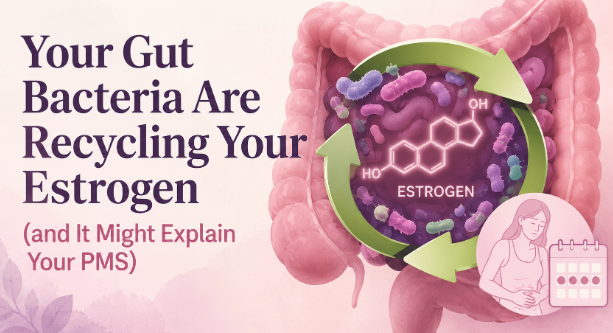
Too much beta-glucuronidase means estrogen that should be leaving your body gets pulled back into circulation. Recycled. Reactivated. Your body ends up exposed to more estrogen than it was ever meant to handle, and the symptoms pile up. PMS. PMDD. Acne. Depression. Heavy, painful periods. Brain fog.
“The estrobolome is kind of like the estro-biome,” explains Dr. Rose, a naturopathic physician with two decades of experience in women’s digestive and hormonal health. “It’s the specific part of the gut microbiome in charge of estrogen metabolism, the recycling of estrogen, how much exposure the body has to estrogen.”
How Your Gut Recycles Estrogen (When It Should Be Eliminating It)
Follow the pathway.
Estrogen is made primarily in the ovaries, with smaller amounts produced in the adrenal glands and fat tissue. It does essential work throughout the body. Bone density. Fertility. Mood regulation. Joint health. Skin elasticity. When estrogen levels are stable, women typically feel their best, often right around mid-cycle.
After estrogen does its job, it travels through the bloodstream to the liver. The liver conjugates it (binds it up into a form the body can safely discard) and sends it down into the gut for elimination through stool.
That’s the plan, anyway.
If the gut microbiome is imbalanced, beta-glucuronidase goes up. This enzyme essentially undoes the liver’s work. It strips the binding off the estrogen, freeing it back into circulation. Instead of being eliminated, the estrogen gets a second pass through the body. Sometimes a third.
Now there’s too much estrogen hitting receptors throughout the body. The premenstrual window, when estrogen naturally drops, becomes a rollercoaster. Mood crashes. Physical symptoms amplify. Two weeks of every month become miserable.
“Half of the month she’s debilitated,” Dr. Rose says. “That’s PMS. It can be both emotional and physical.”
The Constipation Connection
This is where it gets practical and uncomfortable.
If a woman isn’t having regular daily bowel movements, estrogen sits in the gut longer. The longer it sits, the more opportunity beta-glucuronidase has to deconjugate it and send it back into the bloodstream.
“If she’s not eliminating, there’s a higher likelihood that beta-glucuronidase is going to be elevated and it’s going to basically deconjugate the estrogen,” Dr. Rose explains. “So rather than getting bound up and passed out through the stool, it’s in the system longer than it should be.”
Constipation isn’t just uncomfortable. It’s an active contributor to estrogen dominance.
And here’s what most women don’t realize: taking a laxative doesn’t solve the problem. Laxatives work on the very end of the digestive system, forcing the colon to contract or drawing water in to soften stool. They don’t help the liver conjugate estrogen. They don’t improve bile production. They don’t rebalance the microbiome.
You’re flushing the pipe without fixing the plumbing.
Why Birth Control Doesn’t Fix the Root Cause
So a woman goes to her doctor with PMS that ruins half her month. Maybe acne that won’t clear. Maybe anxiety that appeared out of nowhere in her late 30s.
The most common prescription? Oral birth control.
There’s a logic to it. Birth control regulates the cycle, smooths out the hormonal peaks and valleys. For some women, it does reduce symptoms. But it doesn’t address why the estrogen was out of balance in the first place. It doesn’t look at the gut. It doesn’t evaluate liver function. It doesn’t measure beta-glucuronidase.
“Birth control is just adding in more estrogen,” Dr. Rose says. “It’s not figuring out what’s happening with the existing estrogen. Is it getting metabolized correctly? Is it getting eliminated correctly?”
The other common response is antidepressants. And for some women, the mood symptoms are severe enough that medication makes sense as a bridge. But when the depression and anxiety are driven by estrogen’s effect on neurotransmitters, an antidepressant alone misses the root cause entirely.
Here’s why that matters. Estrogen modulates serotonin, dopamine, GABA, and a compound called BDNF (brain-derived neurotrophic factor, responsible for learning, memory, and emotional resilience). When estrogen is stable, those neurotransmitters function well. Mental clarity. Emotional regulation. The ability to handle stress without falling apart.
Ninety percent of serotonin production and metabolism occurs in the gut. If the estrobolome is imbalanced and driving gut inflammation, serotonin takes a direct hit. The mood symptoms aren’t “in her head.” They’re in her gut.
“Estrogen acts like a regulator of all of those neurotransmitters,” Dr. Rose says. “When it’s stable, there’s going to be mental clarity, emotional regulation, and they’re going to feel like they can handle stress better.”
This same mechanism drives postpartum depression. Estrogen is sky-high during pregnancy. After delivery, it plummets. That sharp drop can be devastating. It’s also the mechanism behind perimenopausal anxiety and depression, when estrogen starts fluctuating wildly as the ovaries slow down. The pattern is the same. Estrogen instability destabilizes everything downstream.
What Actually Helps
If the problem lives in the gut-liver-estrogen pathway, the solution has to address all three. Not just one piece.
Get the bowels moving, properly. Dietary fiber is first. Increasing vegetables, adding insoluble fiber, sometimes removing foods that contribute to constipation (dairy and gluten are common culprits). Magnesium can help with motility. The goal is a daily, unforced bowel movement. Every single day.
Support the liver. The liver has to conjugate estrogen effectively for elimination to work. Castor oil packs applied topically over the liver are an old, safe, accessible tool for supporting that process. Botanical and nutraceutical liver support can help as well. Ox bile supplementation supports the bile flow between the liver and the intestines, which is a critical piece of the elimination chain.
Test the microbiome. A standard stool test won’t show this. Neither will a colonoscopy (which screens for cancer, polyps, and inflammatory bowel disease, and remains an important screening tool). A functional GI map can show beta-glucuronidase levels, specific microbial species and their ratios, and inflammatory markers like calprotectin. This is the test that actually reveals what’s happening in the estrobolome.
Stabilize the hormones. For women in perimenopause or with significant cycle-related symptoms, a low, consistent dose of bioidentical estradiol can help prevent the dramatic estrogen swings that trigger the worst symptoms. Bioidentical progesterone can support the premenstrual phase, particularly the mental health piece. These aren’t masking symptoms. They’re stabilizing a system that’s become erratic.
Check the basics. Vitamin D, B12, iron, magnesium. Deficiencies in any of these compound the fatigue, mood disruption, and inflammation that estrogen imbalance is already causing.
None of these steps work in isolation. That’s the whole point. The gut affects the liver. The liver affects estrogen clearance. Estrogen levels affect neurotransmitters. Neurotransmitters affect mood, sleep, and cognition. Pulling one thread doesn’t unravel the knot. You have to address the system.
The Bigger Picture
PMS isn’t a personality flaw. Premenstrual depression isn’t a character weakness. These are biological consequences of a metabolic pathway that’s gone sideways, often starting in the gut.
The estrobolome is not fringe science. It’s a measurable, testable part of the microbiome with a direct, documentable impact on how much estrogen circulates in a woman’s body. The fact that most conventional providers have never heard the term doesn’t mean it isn’t real. It means the conversation hasn’t caught up yet.
If you’ve been told your labs are normal while your body tells you otherwise, if half your month feels like a war zone, if you’ve been handed birth control or antidepressants without anyone asking about your digestion, consider that the answer might be sitting in a part of your biology nobody thought to look at.
Your gut bacteria have opinions about your estrogen. It might be time to find out what they’re doing with it.
About the Author: Dr. Rose is a naturopathic physician and licensed acupuncturist at Med Matrix (medmatrixusa.com), a functional medicine clinic in South Portland, Maine. With two decades of experience in digestive health and women’s hormonal wellness, she specializes in the gut-hormone connection and bioidentical hormone therapy.